Comparing humans and deep nets via the latent dimensions that drive their behaviour. The same task — same data — yet humans organise objects by what they are, while networks organise them by what they look like.
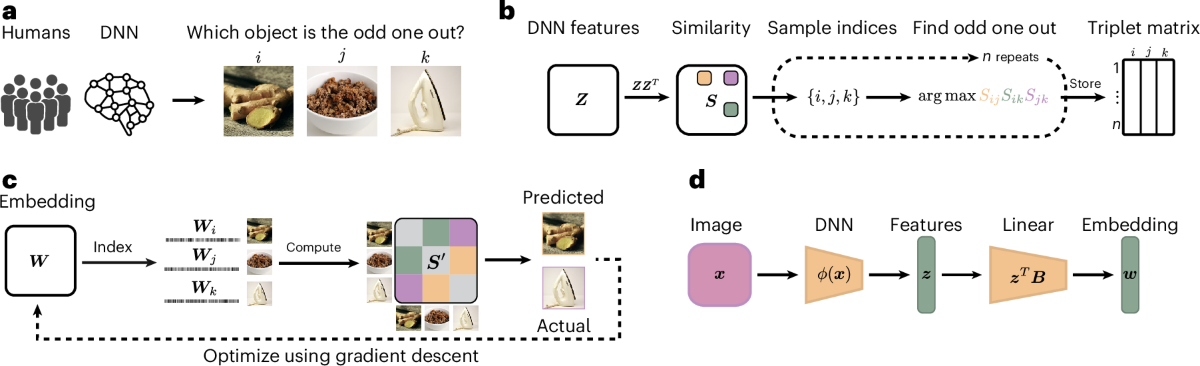
The Question
Two systems can score the same on a benchmark and still represent the world differently. We wanted to know how.
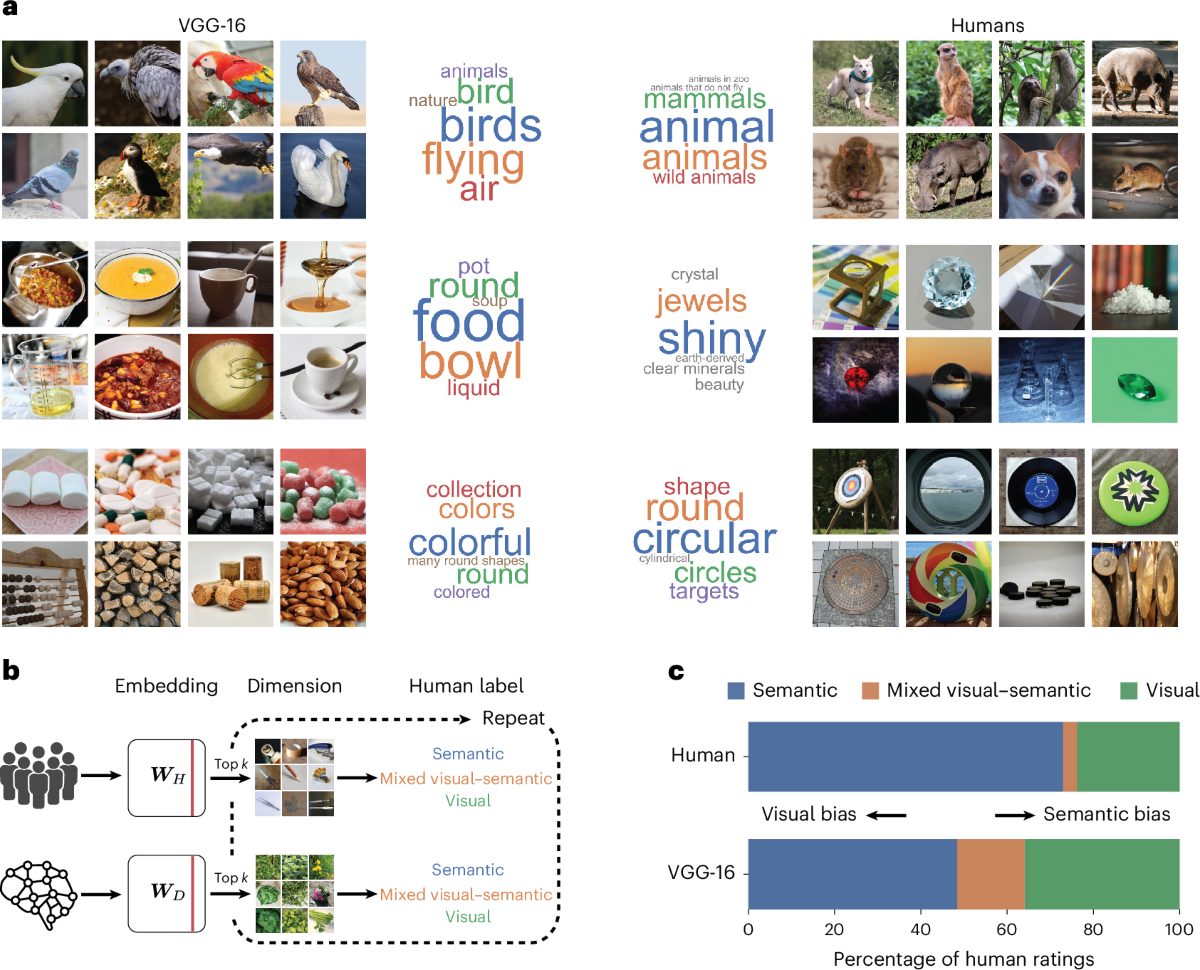
The Approach
A common embedding from a common task. No model surgery, no probes — only the behaviour.
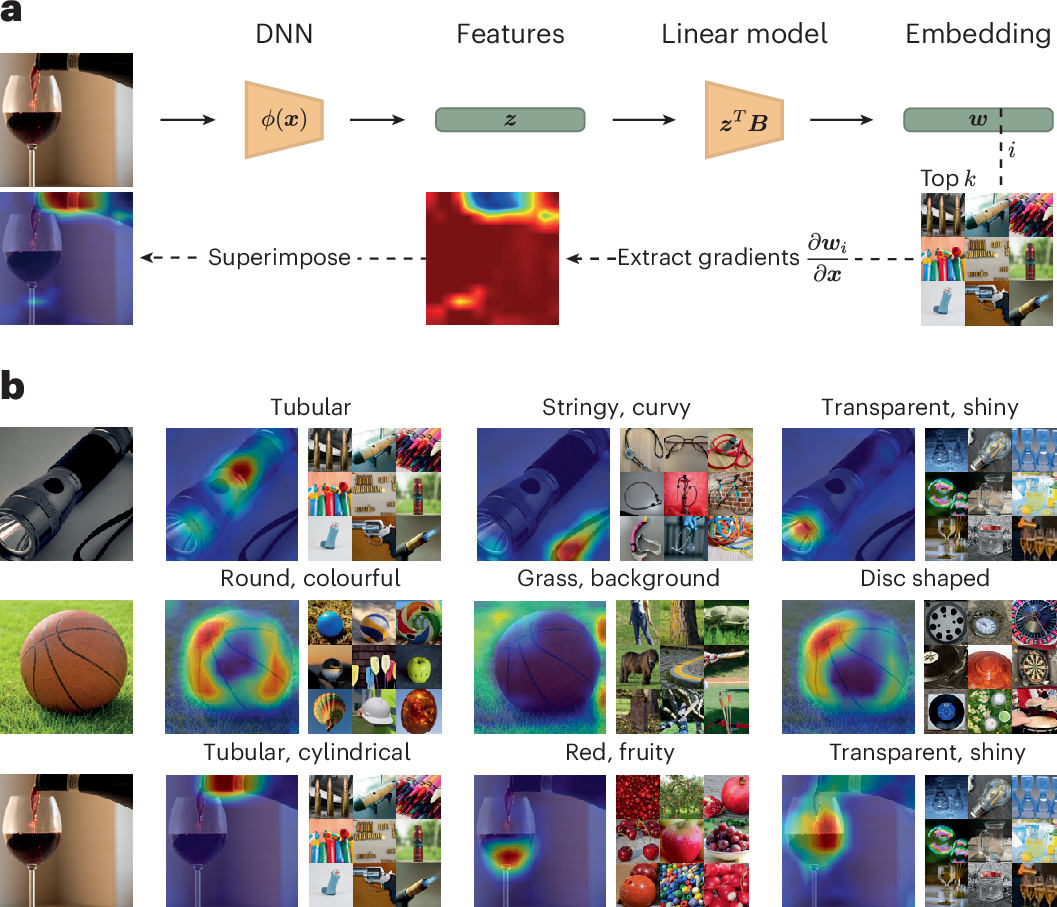
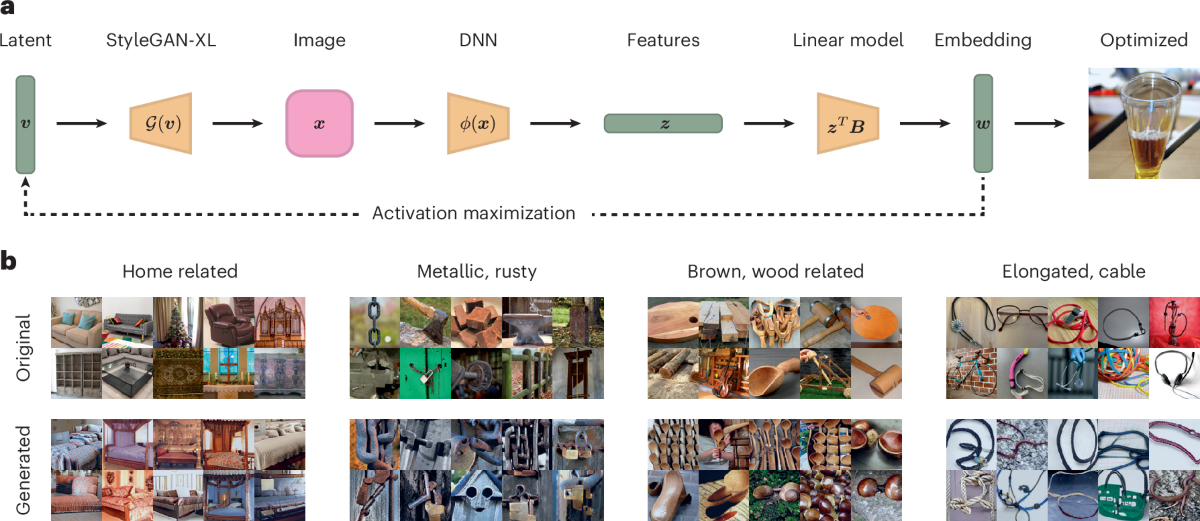
What We Found
Networks lean visual; humans lean semantic. The match is good in the middle and breaks down at the edges — and the breakdown is principled, not noise.
BibTeX
@article{mahner2025dimensions,
  title   = {Dimensions underlying the representational alignment of deep neural networks with humans},
  author  = {Mahner, Florian P. and Muttenthaler, Lukas and G\"u\c{c}l\"u, Umut and Hebart, Martin N.},
  journal = {Nature Machine Intelligence},
  volume  = {7},
  pages   = {848--859},
  year    = {2025},
  doi     = {10.1038/s42256-025-01041-7}
}